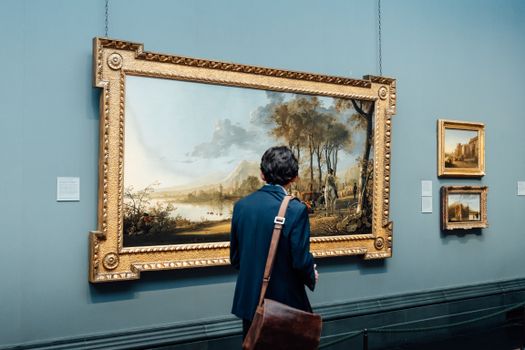
Art has always been more than a reflection of reality; it is a tool that shapes our understanding, stirs our imagination, and even bends our perceptions of fundamental concepts like time and space. From ancient cave paintings to modern installations, artists have continually challenged the boundaries of how we experience the world around us. But how exactly does art influence our perception of time and space? Through careful manipulation of visual, sensory, and conceptual elements, art can stretch, compress, or even suspend our sense of time, and reimagine the very dimensions of space we inhabit.
In this article, we will explore the fascinating ways in which art molds our notions of time and space, drawing on examples across history, neuroscience, and contemporary practice. We will examine the psychological mechanisms at play, compare different artistic approaches, and highlight the profound impact that art has on both individual and collective perceptions.
The Psychological Basis: How Art Alters Our Sense of Time and Space
Our perception of time and space is not fixed; it is a fluid construct shaped by our brains in response to sensory input. Psychological studies have shown that engaging with art can alter the way we process both time and space, sometimes in dramatic ways.
.png)
For instance, a 2014 study published in "Frontiers in Psychology" found that participants who viewed abstract paintings reported a distorted sense of time, with some artworks making minutes feel like seconds and others stretching perceived time far beyond the actual viewing period. This phenomenon, known as "temporal dilation," is triggered when the brain encounters complex or emotionally charged stimuli, causing it to devote more attention and cognitive resources to interpreting the artwork.
Similarly, the perception of space is also highly malleable. Neurological research reveals that our brains use visual cues like perspective, color, and composition to construct an internal model of spatial relationships. Artists have long exploited these mechanisms: Renaissance painters mastered linear perspective to create the illusion of depth, while Cubists like Picasso shattered spatial coherence to present multiple viewpoints at once.
These psychological effects are not limited to paintings. Immersive installations, sculptures, and even digital art forms can all manipulate viewers' temporal and spatial awareness, leading to heightened states of reflection, wonder, or even disorientation.
Historical Perspectives: Art Movements That Transformed Time and Space
Throughout history, various art movements have intentionally explored and redefined the relationship between art, time, and space. Each era brought fresh perspectives and techniques that engaged viewers in new perceptual experiences.
The Renaissance (14th–17th centuries) marked a turning point in the representation of space. Artists like Leonardo da Vinci and Raphael employed mathematical principles and vanishing points to simulate realistic three-dimensional environments on two-dimensional surfaces. Their works conveyed a rational, ordered universe where time and space were harmonized and predictable.
In stark contrast, the Impressionists of the late 19th century, such as Claude Monet and Edgar Degas, shifted focus toward the fleeting, subjective experience of a moment. Their rapid, expressive brushstrokes captured the transient effects of light and movement, emphasizing the passage of time and the impermanence of perception.
The 20th century saw even more radical experimentation. Cubists like Georges Braque and Pablo Picasso deconstructed objects and figures, presenting them from multiple angles simultaneously. This challenged the viewer’s spatial logic and created a sense of time unfolding within a single image. Later, Surrealists like Salvador Dalí distorted time itself, as in his famous painting "The Persistence of Memory" (1931), where melting clocks evoke a dreamlike, elastic temporality.
Contemporary Art: Immersive Experiences and Digital Frontiers
In the 21st century, advances in technology and new artistic mediums have expanded the ways art can manipulate time and space. Installations, virtual reality (VR), and interactive digital works offer immersive environments that engage multiple senses and actively involve viewers in the construction of meaning.
A striking example is Yayoi Kusama’s "Infinity Mirror Rooms." By surrounding visitors with mirrors and carefully placed lights, Kusama creates a space that appears boundless, eliminating clear spatial boundaries and evoking a sensation of timelessness. According to the Hirshhorn Museum, over 475,000 people visited Kusama's "Infinity Mirrors" exhibition during its 2017 Washington, D.C. run, underscoring the powerful draw of such experiential art.
Digital art offers even more possibilities. Time-based media, such as video installations by Bill Viola, unfold over minutes or hours, compelling audiences to slow down and immerse themselves in the passage of time. Meanwhile, augmented reality (AR) applications can overlay digital elements onto the physical world, transforming familiar environments and challenging our everyday perceptions of space.
Art and the Brain: Neuroscience Behind Perceptual Shifts
The impact of art on our perception of time and space is not merely anecdotal; it is grounded in neuroscience. When we view or engage with art, several regions of the brain work together to interpret visual information and construct our sense of reality.
The parietal lobe is responsible for integrating sensory input and spatial orientation. When confronted with ambiguous or unfamiliar artistic compositions, this region must work harder to reconcile the conflicting cues, often resulting in altered spatial awareness. For instance, works by Dutch graphic artist M.C. Escher, such as "Relativity" (1953), create visual paradoxes that confuse the brain’s spatial mapping, leading to a feeling of impossible or infinite space.
In terms of time perception, the prefrontal cortex plays a crucial role. Viewing emotionally charged or complex art can increase activation in this area, causing subjective time to slow down or speed up. This is why some gallery-goers may find themselves lost in a single painting for what feels like hours, while others breeze through an entire exhibit in less time than they realize.
A study conducted at the University of London in 2011 found that viewing art that subjects found "beautiful" led to increased blood flow in the brain by up to 10 percent—comparable to looking at a loved one. This heightened attention can fundamentally change how we process time and space in the moment.
Comparing Artistic Approaches to Time and Space
Artists across cultures and eras have utilized a variety of methods to influence perceptions of time and space. Below is a comparative table highlighting key differences in approach:
| Art Movement/Style | Key Technique | Effect on Perception of Time | Effect on Perception of Space | Example Artwork |
|---|---|---|---|---|
| Renaissance | Linear Perspective | Stable, continuous time | Realistic, rational depth | Leonardo da Vinci, "The Last Supper" |
| Impressionism | Expressive Brushwork | Ephemeral, fleeting moments | Blurred, shifting spaces | Claude Monet, "Impression, Sunrise" |
| Cubism | Multiple Perspectives | Simultaneity, fragmented time | Disjointed, overlapping planes | Pablo Picasso, "Les Demoiselles d'Avignon" |
| Surrealism | Dream Imagery | Elastic, dreamlike time | Distorted, fantastical spaces | Salvador Dalí, "The Persistence of Memory" |
| Contemporary/Installation | Immersive Environments | Suspended or cyclical time | Infinite or undefined space | Yayoi Kusama, "Infinity Mirror Room" |
This comparison underscores the diversity of artistic strategies used to reshape how we experience the fundamental dimensions of existence.
The Role of the Viewer: Participation and Subjectivity
While artists provide the framework, it is the viewer who ultimately completes the perceptual experience. Our individual backgrounds, emotions, and cognitive states profoundly influence how art affects our sense of time and space.
For example, a 2017 survey by the Art Fund in the UK found that 63% of museum-goers reported feeling "transported to another world" when viewing art, while 41% said they lost track of time during their visit. This suggests that the immersive power of art depends as much on the participant’s openness and engagement as it does on the artwork itself.
Performance art and participatory installations push this dynamic even further. Works by artists like Marina Abramović, who famously sat in silence with visitors during her piece "The Artist Is Present" (2010), highlight the shared creation of time and space between artist and audience. In such contexts, the boundaries between real and imagined, present and eternal, become fluid and negotiable.
Broader Implications: Art as a Catalyst for Expanding Perception
The ability of art to reshape our sense of time and space has far-reaching implications beyond the walls of galleries and museums. By encouraging us to question what we take for granted, art expands our cognitive and emotional horizons.
In education, exposure to artworks that challenge linear time or fixed spatial arrangements can foster critical thinking and creativity among students. In mental health contexts, art therapy often leverages altered perceptions of time and space to help individuals process trauma or anxiety by offering new frameworks for understanding their experiences.
Moreover, in our fast-paced digital age—where attention is fragmented and the distinction between physical and virtual space grows ever more blurred—the role of art in grounding, stretching, or suspending time and space becomes increasingly relevant. Engaging deeply with art provides a rare opportunity to pause, reflect, and reconnect with the richer dimensions of human experience.